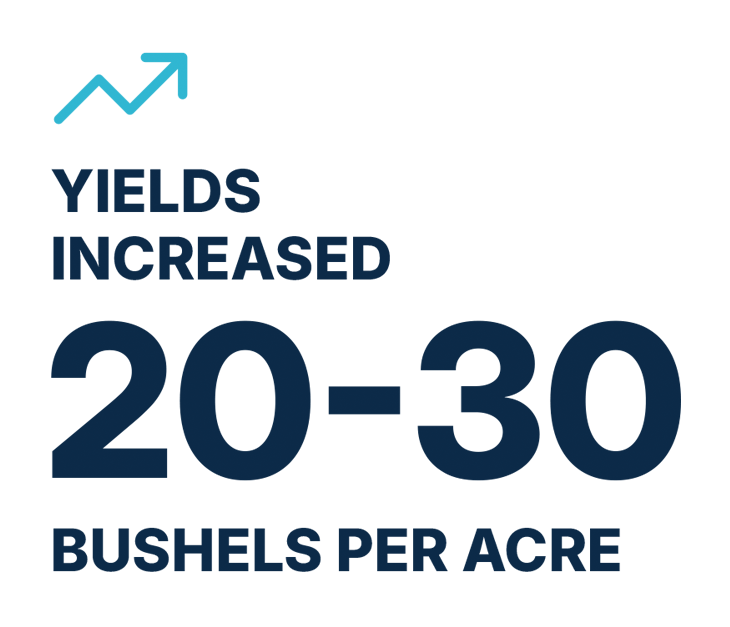
Irrigation equipment dealer Hoffman Irrigation used 200 CropX V4 sensors across diverse soils and crops to give growers a simple “yes or no” on when to irrigate—reducing second-guessing, avoiding unnecessary passes in variable rainfall years, and supporting stronger yields for customers who follow the recommendations. Growers that closely followed the technology achieved yield improvements of 20-30 bu/ac.
Organization: Hoffman Irrigation, Oakes, North Dakota
Business Type: Irrigation equipment dealership (Reinke Irrigation)
Territory: North Dakota, South Dakota, and Minnesota
Crops: Corn, soybeans, potatoes, onions, wine grapes
Primary Challenge: Reliable, actionable irrigation guidance across highly variable soils
Solution: CropX V4 soil sensors + app-based recommendations + dealer-led support
Scale: 200 sensors deployed across hundreds of growers
Across the Northern Plains, irrigation decisions aren’t made in a vacuum. Growers compare notes, watch neighboring pivots, and often default to habit—especially when soil conditions can shift from blow sand to heavy loam, gravel, and everything in between. For Hoffman Irrigation, the question from customers was consistent: provide a dependable tool that doesn’t just produce data, but gives clear guidance on whether it’s time to run.
“We wanted something dependable that tells them yes or no—especially in the blow sand that we have,” said Brandon Meyer, who works in sales at Hoffman Irrigation in Oakes, North Dakota.
Before CropX, Hoffman and its customers relied on other soil probe systems that could be difficult to maintain and hard to trust. Brandon described familiar frustrations: air gaps, messy installation workarounds, and the burden of keeping sensors functioning in real-world field conditions.
“People just wanted a more dependable probe,” Brandon said. “They were sick of some of the older sensors on the market — the air gaps and the slurry…and having to dig a pole out of the ground.”
For Hoffman, switching wasn’t only about improving the data. It was about reducing friction for growers who needed answers they could act on quickly—without extra steps, extra maintenance, or extra uncertainty.
Hoffman began adopting CropX before its broader partnership with Reinke gained momentum. As adoption grew, so did the footprint: today, the team supports roughly 200 CropX sensors in the field, with nearly all of them being fourth-generation (V4) units.
The deployment spans a large geography—covering most of North Dakota up past Highway 2, stretching toward Bismarck and Grand Forks, crossing into Minnesota near Sauk Centre, and extending down into South Dakota near Watertown. The sensor network supports the crops Hoffman sees most often—corn, soybeans, and potatoes—plus pockets of specialty production like onions and even wine grapes.
For growers, the appeal went beyond the sensors in the ground. The system delivered clarity they could use day-to-day, especially as conditions changed across soil type, crop stage, and weather.
For customers who fully commit, the results can be meaningful. While yield numbers are often sensitive, Brandon shared one standout example from a grower who followed the CropX recommendations exactly.
“He said it was their highest yield he’d ever gotten. He decided to follow the CropX probes recommendation to a Tee…and he saw an increase of 20 or 30 bushels per acre.”
That grower adopted CropX in 2021 and continued using the recommendations year after year. According to Brandon, the farmer has maintained strong yields since—reinforcing what Hoffman sees across its customer base: when trust is established and the recommendations are followed, growers are better positioned to match irrigation timing to real root-zone conditions.
The most visible impact often shows up in the season types growers know well: the years where it rains just enough to create doubt. In those conditions, growers can feel pressure to run because the neighbor is running—whether their own profile actually needs it or not.
“They like knowing—especially in a year where it rains periodically—that they don’t actually have to do it,” Brandon explained. “They don’t have the pressure that their neighbor’s system’s running, so maybe they should run…they’re able to let go of that follow-the-leader mentality.”
In practice, that confidence can translate into fewer unnecessary passes. When profiles show adequate moisture, growers can hold off—reducing pumping, labor, and wear—without wondering whether they’re falling behind.
Looking ahead, Hoffman expects to continue leaning into precision tools that fit into grower workflows without adding complexity. Brandon expects variable rate irrigation (VRI) to remain part of the broader industry direction, and Hoffman continues to test newer tools in the CropX ecosystem—like weather and ET—when those tools help growers make faster, clearer decisions.
For Hoffman Irrigation, the value of CropX is straightforward: dependable sensors, actionable recommendations, and a decision framework that works across variable soils and unpredictable seasons—so growers can irrigate with confidence.
Julia brings with her more than 20 years of experience in corporate development, partnerships, M&As and business strategy.
Prior to joining CropX, Julia held roles such as Corporate Development Director at STK Bio-Ag Technologies, a leading global biopesticide company, and as Deputy Head of M&A at Caisse des Depots et Consignations in France. Earlier in her career, Julia served as an AVP at Lazard Freres Investment Banking and as a Manager at KPMG Corporate Finance.
Julia holds an MBA from ESSEC Business School in France.