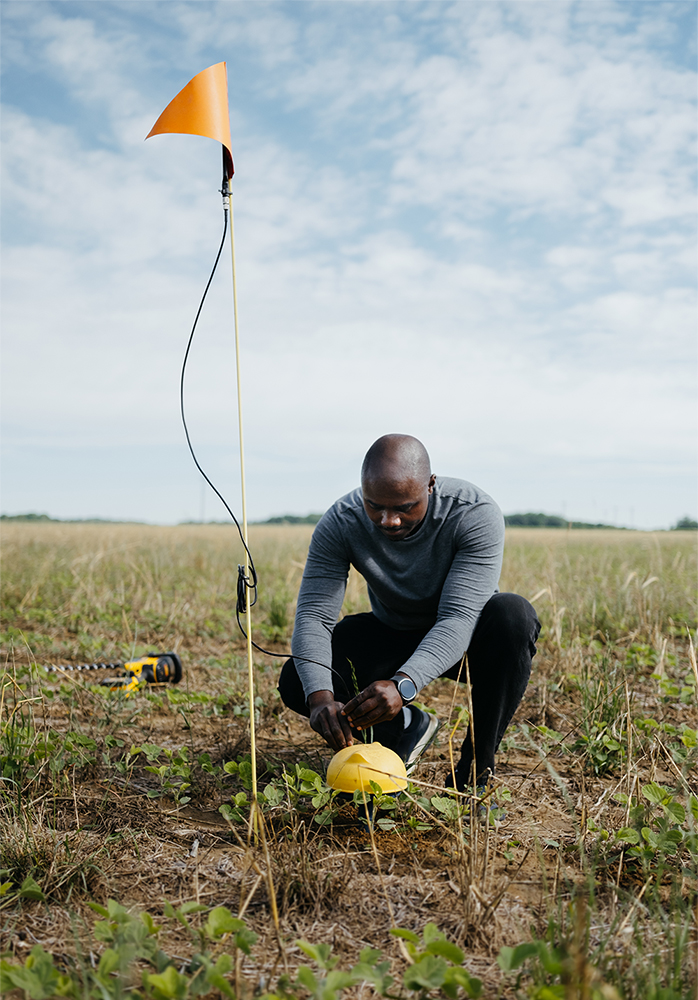
For Sand County Foundation, conservation must work in the real world. As a national nonprofit operating at the intersection of agriculture and environmental improvement, the organization partners with producers to test and refine soil health practices that protect water, build resilience, and sustain profitability. Since fall 2023, Sand County Foundation has deployed more than 60 CropX soil sensors and rain gauges to help farmers visualize how water moves through their soils—helping farmers make better nutrient management decisions, validate conservation practices, and simplify field operations—all managed by a lean, multi-state team.

Organization: Sand County Foundation
Business Type: Agricultural conservation nonprofit
Territory: Soil management programs in Alabama, Mississippi, Kansas, Nebraska, Minnesota, Wisconsin
Primary Challenge: Sourcing reliable agronomic hardware and software with support to match
Solution: CropX soil sensors paired with expert agronomic support to guide irrigation and fertility decisions
Scale: Multi-state operation with 75+ CropX sensors and 25 rain gauges deployed
Founded in the 1960s, Sand County Foundation works nationally to advance voluntary conservation on working lands. Its programs span row crops, ranching, vegetable production, habitat restoration, and forestry. A signature initiative—the Leopold Conservation Award—recognizes farmers who demonstrate leadership in soil health and stewardship.
Within this mission, Sam Kwakye serves as an agriculture field data scientist. His role bridges methodology and practice: reviewing field protocols, overseeing data collection, and ensuring that farmers have access to credible, actionable information. Much of his work focuses on helping producers understand how management decisions—such as reduced tillage or other soil health practices—affect water movement and soil dynamics below the surface.
Before adopting CropX, Sand County Foundation relied on another digital platform to support its Farmer to Farmer Initiative, an EPA- and Daybreak-funded program designed to introduce farmers to commercially available, real-time decision tools.
As a small, grant-funded organization, every technology decision carries weight. “If it doesn’t work, it’s hard to go back and ask for funding to try something else,” Sam explains. Field reliability is critical—not just for farmer trust, but for long-term program viability.
Operationally, the previous system created strain. Sam lives in Florida, while many project fields are in Mississippi and Alabama. Field visits must be tightly planned, and when connectivity or transmission issues arise during installation, delays can derail an entire trip. Hardware complexity also meant installations often required hours on-site, limiting scalability across multiple states.

Sand County Foundation finalized its transition to CropX in fall 2023. Two factors quickly stood out: responsive support and simplified hardware.
“When I’m in the field and something isn’t connecting, I need the quickest response possible,” Sam says. With CropX, support has been consistently available during installations—helping resolve connectivity questions in real time and ensuring sensors are fully operational before he leaves the farm.
The hardware itself has changed the workflow. Unlike previous systems that required extended, expert-led installations, CropX sensors can be installed, removed, and relocated with minimal complexity. In several cases, farmers have completed installations themselves while Sam’s team monitored connectivity and data remotely.
For a lean nonprofit managing more than 75 sensors—and preparing to deploy roughly 60 more in Nebraska and Kansas—that flexibility changes what’s possible.
At the core of Sand County Foundation’s conservation work is a simple question: How do management practices change the way soil handles water?
By pairing soil health champions with more conventional management systems, the team uses sensors to monitor moisture trends, infiltration, and how quickly soils recharge or dry down after rainfall. Farmers can see how water decreases after a storm, how long moisture is retained, and when the next irrigation event is truly necessary.
For some producers, this has translated into more confident irrigation decisions—including knowing when not to irrigate. Avoiding unnecessary passes can reduce water use, fuel costs, and labor, while reinforcing the agronomic benefits of improved soil structure.
The visual nature of the data has also strengthened peer learning. With integrated rain gauges and real-time dashboards, farmers can share results with neighbors—demonstrating how conservation practices influence field performance in tangible ways.

Sand County Foundation has now completed two full years of data collection across paired fields in Alabama and Mississippi. Results from 13 paired field comparisons tell a clear story: fields managed under soil health practices with CropX soil sensors stored an average of 0.44 inches (11.1 mm) more water in the soil profile than conventionally managed fields—translating to an estimated 11,861 fewer gallons of runoff per acre-inch.
That difference matters. In a region where rainfall can be intense and soils variable, retaining nearly half an inch more water means less erosion, more moisture available to the crop between rain events, and a stronger case for the long-term value of conservation management. Operational gains have been equally clear—faster installations, remote monitoring, and dependable support have reduced field risk and freed staff time for farmer engagement.
For Sand County Foundation, technology is not the headline—it is the enabler. By making below-ground dynamics visible and measurable, the organization is helping farmers lead conservation from the field up, backed by two years of real-world data they can point to and share with neighbors.
Julia brings with her more than 20 years of experience in corporate development, partnerships, M&As and business strategy.
Prior to joining CropX, Julia held roles such as Corporate Development Director at STK Bio-Ag Technologies, a leading global biopesticide company, and as Deputy Head of M&A at Caisse des Depots et Consignations in France. Earlier in her career, Julia served as an AVP at Lazard Freres Investment Banking and as a Manager at KPMG Corporate Finance.
Julia holds an MBA from ESSEC Business School in France.