The Blueprint for Slowing Aquifer Decline Already Exists, and It’s Working Right Now
In Sheridan County, Kansas, a group of irrigators did something most of the American High Plains has struggled to do for decades: they got a declining aquifer to stop declining, without giving up farm income to do it. They agreed to a collective cap on total groundwater pumping, then used real-time soil moisture monitoring and precise irrigation scheduling to hit that cap without guessing. The result has reportedly come close to net-zero aquifer depletion, a genuinely different outcome than the region’s broader trend line.
We hear a version of the same question from growers and advisors constantly: does any of this technology actually change the long-term picture, or does it just make this season a little easier? Sheridan County is the clearest answer we know of. It did both, and the same combination – precise field data plus a shared local goal – is repeatable well beyond one Kansas county.
That’s the real headline buried inside a recent county-level analysis from the University of Nebraska–Lincoln’s Daugherty Water for Food Global Institute, which found irrigated farmland nationally grew by more than 3 million acres between 1997 and 2022, even as some regions declined and others expanded. The national number isn’t the story. The story is that precise, field-level data is what turns a shared water goal into an achievable one, wherever that goal already exists.
At a glance:
Sheridan County, Kansas essentially halted its aquifer decline while keeping farm income steady, using soil moisture data paired with a local pumping agreement.
That same model applies anywhere growers, advisors, and local water authorities already share a conservation goal.
Real-time field data, not guesswork, is what makes hitting a tight water budget possible without sacrificing yield.
Root-Zone Precision Is the Foundation
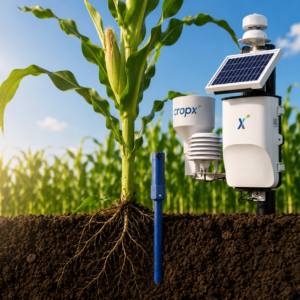
What made Sheridan County’s result possible wasn’t restraint alone; it was knowing exactly how much water was actually available in the root zone, at what depth, at any given moment. A multi-depth soil sensor like CropX Apex, which reads moisture, temperature, and salinity every four inches across the full root profile, gives a grower the kind of granular picture that makes a tight water budget workable rather than a guessing game. Pair that with a device like CropX Vertex, built for straightforward, do-it-yourself installation with no separate telemetry required, and even a grower without a large operations team can get precise, actionable data flowing in a single afternoon.
Timing Beats Rainfall Totals
The same principle shows up in a completely different setting: the historically rainfed Midwest, Eastern U.S., and Mississippi River Valley, where more farmers are adding irrigation not because of drought, but because rainfall has become less reliably timed to the growing season. Michael Avi Gross, agronomist and researcher at CropX, emphasizes that just like nitrogen leaching, this is a timing problem – not a supply problem. A grower catching those two or three critical weeks precisely, rather than applying water on a fixed calendar, gets the benefit of irrigation without over-applying in what’s often still a wet year overall.
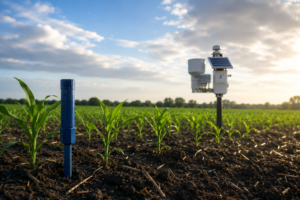
CropX Evato, the first sensor of its kind to measure actual evapotranspiration in real time at the field level, paired with the Rivo rain gauge for hyper-local rainfall data, gives exactly that picture: how much water the crop is really using, and how much rain actually reached the field, rather than a regional average standing in for either. It’s a small enough setup that a grower can be running on precise, field-specific data within days of a first-time irrigation decision, not seasons.
A Pattern That Holds Up Globally
This isn’t a uniquely American story, either. In Spain’s Júcar river basin, on the Mediterranean coast, regulators pair investment in irrigation efficiency directly with measurable allocation targets, and the pattern holds: precise field data plus a clear, shared goal produces results that efficiency alone doesn’t. Wherever a region already has that kind of shared target in place, whether set by a local water district, a national regulation, or a voluntary grower agreement, field-level precision is what turns the goal into a result rather than an aspiration.
Scaling the Model Further
For agronomic advisors and enterprise agribusinesses managing this across many fields or many growers at once, the same logic scales. To reap the benefits, our team recommends installing the CropX Telemetry device to pull your existing sensors and fields into the CropX software layer. From irrigation planning to sustainability reporting, CropX turns your field-level sensor data into the kind of documentation a water district, auditor, or buyer actually wants to see. As Nic Stoll, CropX’s North America operations leader, points out, this model works best precisely where local rules already limit new irrigated acreage: in those regions, saved water can’t simply be redirected into more acres, so it goes toward the goal it was intended for.
Where This Isn’t the Whole Answer
It’s worth being direct about one thing: not every region losing irrigated farmland is losing it to a water problem this technology solves. In Florida, farmland is converting to residential and solar development; in parts of Colorado, water rights are being sold to growing cities. Neither is a field-efficiency question, and treating them as one risks overpromising. Where the mechanism is groundwater depletion, though, the Sheridan County result says the blueprint already exists, and it’s one growers, advisors, and enterprise operations anywhere in the world can put to work today, not someday.