
For nearly 50 years, Farm-Tech has built its reputation on helping growers make better agronomic decisions. Now the Minnesota-based consultancy is applying that same discipline to water. Through a program called “Water Watch”—built on CropX sensors and software—Farm-Tech helps growers ranging from small family operations to large effluent-heavy enterprises apply the right amount of water at the right time, while staying agronomically sound and regulator-ready.
Organization: Farm-Tech, Adams, Minnesota
Business Type: Agronomic consulting and irrigation services
Territory: Minnesota and surrounding regions
Crops: Corn, soybeans, sweet corn, peas, seed corn, dry beans, forage grass
Primary Challenge: Managing irrigation and effluent water across variable soils and regulatory constraints
Solución: Sensores de suelo CropX con software integrado de soporte para la toma de decisiones de riego
Scale: CropX sensors and software integrated into consulting-led Water Watch program
Farm-Tech was founded as a soil sampling and agronomic consulting business, long before digital tools entered the picture. That consulting mindset still drives the company today, according to General Manager John Krull. “Controlling your controllables has always been our focus,” he explains, and water was one of the biggest variables they couldn’t fully see.
As the company began selling and supporting Reinke irrigation systems, it became clear that growers needed more than hardware. Questions about when to irrigate, how much to apply, and how soil type affected water availability came up repeatedly. Without in-field data, recommendations often relied on experience and intuition rather than measurement.
That gap pushed Farm-Tech to look for soil sensing technology that could complement its agronomic services. Becoming a CropX dealer allowed the team to extend its consulting approach below the soil surface and into daily irrigation decisions.
The challenge grew more complex as Farm-Tech began working with customers managing large volumes of effluent water, including dairy and food processing operations. In these cases, irrigation wasn’t only about maximizing crop performance—it was also about safely and legally disposing of water.
Unlike traditional crop irrigation, effluent application often aims to push as much water as possible through the soil without causing runoff. “We’re using the soil as a natural filter,” Krull says. Staying within regulatory limits meant knowing soil capacity in real time and adjusting application daily.
Before dedicated effluent tools were available, Farm-Tech relied on limited sensors and manual judgment. That approach worked, but it left little margin for error. The introduction of CropX’s effluent-focused capabilities gave the team a clearer framework for maximizing disposal while remaining compliant.
Early on when managing effluent irrigation, Farm-Tech placed one or two sensors across large irrigated areas. Over time, the team refined its strategy. When working with effluent irrigation today, they deploy multiple sensors under each pivot, aligned with different soil types and management zones.
This shift allowed agronomists to fine-tune recommendations rather than averaging conditions across an entire field. Sandy areas, heavier soils, and variable root zones could each be managed according to their actual water-holding capacity.
The result is more efficient application and fewer surprises. “We’re not guessing anymore,” Krull notes. “We can see what a quarter-inch did—or didn’t do—at depth.”
One of the most impactful tools for Farm-Tech has been CropX’s graphing and visualization features. Agronomists regularly sit down with growers to review soil moisture graphs alongside crop growth stages, showing how water use changes as plants develop.
These conversations often challenge long-held habits. Some growers prefer frequent, light applications to avoid mud or slow pivot turns. Sensor data, however, reveals that shallow watering often fails to reach the root zone, increasing evaporation and disease risk without delivering real benefit.
“When they see it on the graph, it clicks,” says staff agronomist Winston Smith. Over time, more growers have adjusted application depth and timing, spreading irrigation events further apart and improving water penetration.
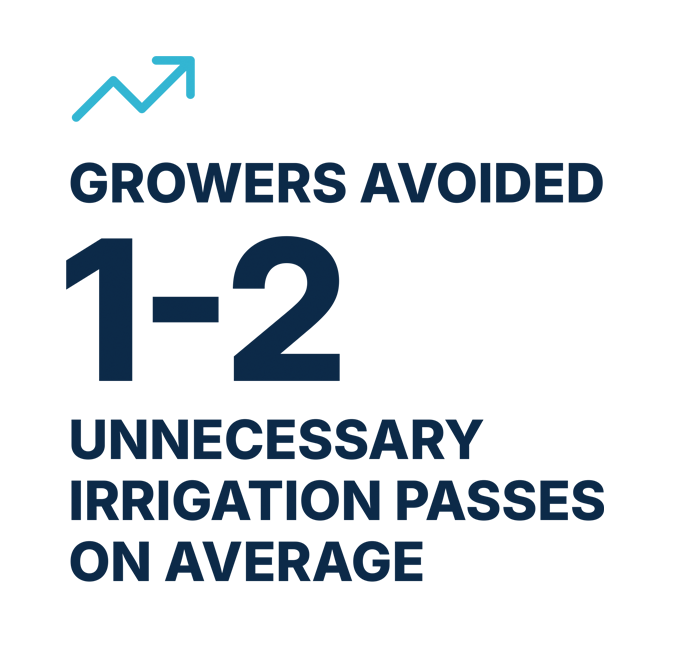
In one example, a dairy operation growing corn silage installed sensors for the first time early in the season. At V5–V7, the growers assumed irrigation was needed, but sensor data showed adequate moisture. They delayed watering, saving time and avoiding unnecessary passes.
Later, during reproductive stages, an inch-and-a-half rain seemed sufficient—until the sensors showed rapid depletion driven by strong crop demand. The pivot went back on sooner than expected, protecting yield at a critical moment.
Rather than focusing solely on total water applied, Smith highlights irrigation timing as the real driver of performance. Delivering water precisely when the crop needed it most—especially during high-demand stages—proved more impactful than volume alone. That shift in approach helped produce a standout silage crop and reinforced grower confidence in using data to guide critical decisions.
Beyond water management, Farm-Tech has found value in using CropX imagery and historical data to diagnose field issues. In one case, imagery helped trace a severe disease pattern back to a fungicide application problem—not an irrigation decision—protecting the credibility of both the agronomic recommendation and the grower relationship.
“These tools give us context,” Krull says. “They help explain what actually happened, instead of pointing fingers.”
As Farm-Tech looks ahead, the goal is steady growth—about 10% annually—despite weather variability and market pressure. Even in wet years, when pivots run less, the team sees long-term value in helping growers understand what’s happening underground.

Julia brings with her more than 20 years of experience in corporate development, partnerships, M&As and business strategy.
Prior to joining CropX, Julia held roles such as Corporate Development Director at STK Bio-Ag Technologies, a leading global biopesticide company, and as Deputy Head of M&A at Caisse des Depots et Consignations in France. Earlier in her career, Julia served as an AVP at Lazard Freres Investment Banking and as a Manager at KPMG Corporate Finance.
Julia holds an MBA from ESSEC Business School in France.